T: 01273 957 726 / E: [email protected]

Solar Coin - The Latest Digital Currency

Source: Forum for the Future / Words: Hugh Knowles

Whilst you are busy trying to catch up with/understand Bitcoin there are digital currencies emerging all over the place. One of the latest ones is SolarCoin. The currency is a "bitcoin-style asset, pegged to units of photovoltaic energy".

"Each SolarCoin can be exchanged for 1MW/hr of solar energy. According to the SolarCoin Foundation, which is stewarding the coin, each unit equates to emissions savings of 1,500lbs of CO2."

SolarCoin will not require as intensive computing to generate each coin and the idea is that awarding "coins to solar energy producers will create fresh incentives for them to invest in solar PV capacity."

Oddly I was discussing a renewable currency with Open Utility last week where an interesting idea emerged. If the postcode of the generation point was encrypted into the currency limiting the currencies use within say 20miles of where it was created then it could be used to subsidise local generation.

Visit SolarCoin here

Like this content? Then follow us on Twitter or register for a FREE ticket for the Eco Technology Show on the 26th – 27th June, The Brighton Centre by clicking here.

The Green Deal: How Far Has Energy Efficiency Come?

Source: Trillion Fund / Words: Rebecca Cooke

This morning, representatives from the UK energy industry met at the Westminster Energy, Environment and Transport (WEET) Forum to review the successes and the pitfalls of one of the government's attempts to plug the gaping holes in the energy efficiency sector: the green deal.

Since its inception in 2010 the green deal has been hailed as one of the coalition government's steps towards affirmative action to tackle energy efficiency, fuel poverty and improve the UK's housing stock. Four years on and it seems that there is nigh on ubiquitous consensus that the policy framework has not delivered on any of these counts.

Last week, The Guardian published a bleak report on just how far the effects of the green deal had come in repairing the damage caused to consumer's finances by lack of energy efficiency. It showed that since February the scheme had signed just 33 new contracts across Britain to take advantage of the new Green Deal Finance plan to retrofit homes with energy efficiency measures. A grossly disappointing figure considering the scheme was initially started with the view to improve 14 million homes across the country.

The sentiment was echoed in the WEET forum today as energy industry representatives said that the green deal had a long way to go if was ever to make a difference to Britain's energy efficiency sector.

Andrew Warren, director of the Association for the Conservation of Energy commented on the5 million UK households battling with fuel poverty. He said: “In 2010 it was the aspiration of all three of the leading political parties to improve 14 million households energy efficiency. In 2000, the government pledged that by 2016 fuel poverty in the UK would have been abolished. I am still waiting to see the measures that need to be taken to see that happen. Today, there are more homes in fuel poverty than there were at the beginning of the century.”

He highlighted a report from the Department of Energy and Climate Change which showed fuel bills would continue to rise in order to cover the £140 billion being spent on infrastructures to combat climate change. Currently around 9 per cent of UK consumer's energy bill is used to finance infrastructure. According to new statistics this will rise to 26 per cent by 2020 if measures to improve energy efficiency are not improved drastically are not taken.

He added: “The fundamental way in which this can be tackled is by improving thermal energy efficiency.”

Despite the fact that the green deal has not yet made marked progress with its' goal of improving the energy efficiency of 14 million household nationally, David Thomas, deputy director of the Green Deal Demand said that since the scheme began four years ago it has benefitted half a million households and has signed 1,760 contracts worth £2.6 million. However the Green Deal Finance has had a dismally slow uptake in part, as energy secretary Ed Davey has said, due to the application process being 'clunky and complex.'

Mr Thomas said that future plans for the green deal would centre around 'increasing uptake of the scheme and helping customers gain access to local community energy offers to drive competition in the market.'

Yet fuel poverty and the lack of provisions to combat it are still plaguing the UK's energy industry. The gravitas of the situation was summarised by Derek Lickorish, the chair of the Fuel Poverty Advisory Group who said: 'It's people's lives that are being affected. Fuel poverty leads to additional winter deaths and higher rates of depression and anxiety for people who cannot heat their homes. The treasury needs to begin to put money from energy bill taxation back into energy efficiency.”

Like this content? Then follow us on Twitter or register for a FREE ticket for the Eco Technology Show on the 26th – 27th June, The Brighton Centre by clicking here.

The Future of Urban Afordability?

Source: Fastcoexist / Words: Adele Peters

London is the most expensive city in the world, and a big part of that because of its housing: In some neighborhoods, the average rent for a one-bedroom apartment is over $4,000. Not surprisingly, it’s pretty hard for young people with little or no income to find a place to live, but a new set of ultra-low-cost homes from the YMCA may help.

The YMCA’s Y:Cube houses are cheap in part because they’re so quick to build; the home is fully constructed and finished in a nearby factory, and then can be set in place almost instantly.

“It’s about speed and process,” says Ivan Harbour, a partner at Roger Stirk Harbour + Partners, the architects for the development. “It’s not reduced quality. The same money--probably actually more money--is spent on the quality of the materials and finishes.”
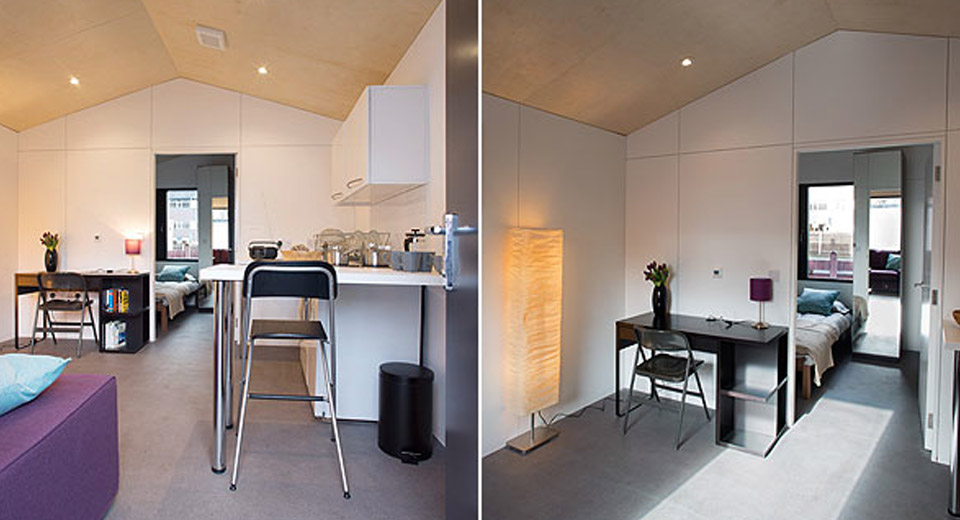
Special timber-framed panels called Insulshell, which architects also used to build the Velodrome for the London Olympics, make the building not only simple to construct, but so airtight it takes almost no energy to heat.

The tiny homes--a little less than 300 square feet for a bedroom, living room, kitchen, and bathroom--are each intended for only one person, but they’re also designed to easily stack on top of each other to form a community. They're reminiscent in some ways of the micro-apartments that have been popping up in other expensive cities, like New York and San Francisco. But it sounds like the Y:Cube homes will be even cheaper.

In Southwest London, the YMCA plans to build 36 of the units as a prototype. Young people who have been living at the YMCA’s hostel, going through a two-year education and employment program, will have the chance to rent one of the apartments below the market rent.

The YMCA has leased the land for five years, and if it needs need to move at the end of the lease, the homes can come along: Each can be picked up by a crane, just as it was installed, and easily carted off to another location (though that may be a little jarring to residents). Since the homes are about 40% cheaper to construct than a traditional building, at about £30,000, the project will pay for itself in 15 years. The YMCA will be able to finance construction using social investors rather than grants.
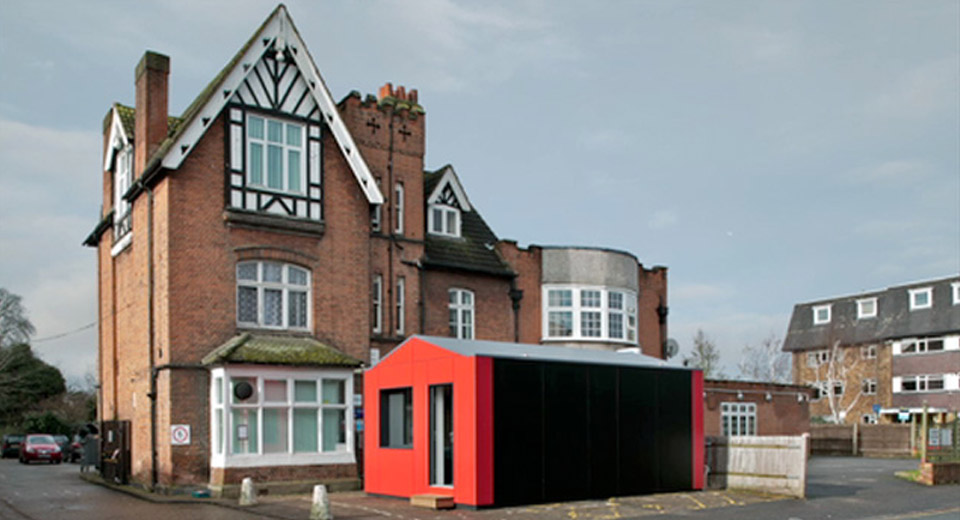
The architects carefully planned each aspect of the exterior, from the gate to the front door, so that the new residents can connect with neighbors. "We're trying to create places where people can go and feel like they're part of the community," says Harbour. "That whole sequence of spaces is essential so people don't feel like they've been ghettoized."

If the model works, the YMCA plans to roll out more locations. The architects point out that the same construction methods could be used to save costs and improve sustainability for everything from larger homes to schools. The portability of the buildings also makes them well-suited for land that can only be developed temporarily, like brownfield sites.

"This technology could be used for almost anything," says Andrew Partridge, an architect on the project. "It's just at the very beginning. This is a great place to start--filling a great need in London right now."

Like this content? Then follow us on Twitter or register for a FREE ticket for the Eco Technology Show on the 26th – 27th June, The Brighton Centre by clicking here.


Low Carbon Heating - Getting Warmer But Not Quite There...

Source: Energy Saving Trust / Words: Gary Hartley

It may seem an obvious point to say that to better manage our energy use, technologies need to be both accessible and clearly explained. But it appears there is still some work to be done to make sure this is the case.

Where heating is concerned, it seems there’s especially some room for improvements. A recent survey of over 2,000 showed some striking misunderstandings about renewable heat. Two-thirds, for example, identified wind turbines and solar PV as renewable heat technologies, while biomass boilers were identified by a quarter, and heat pumps even less. Knowledge of related issues such as where to acquire the fuel for wood-fuelled heating was also low.

At the same time, though, people were positive about reducing energy consumption, and two-thirds had taken action to reduce the energy they use over the last two years. This echoes the findings of all our recent consumer surveys. But nice noises are not enough; despite our work and others’ over the last few decades, there are still significant knowledge gaps to be filled if widespread roll-out of low-carbon technologies is going to be achieved relatively seamlessly.

Then there’s the issue of making sure everyone can have an equal stake in our low-carbon future. RICA, the consumer group for older and disabled people, published some work looking at heating controls, with an energy-saving focus – and made some worrying conclusions. It suggests that people with sight loss may face struggles with many programmers and thermostats on the market – even those aimed specifically at people with visual impairment.

Small text, complex buttons and switches and tactile text in unexpected locations prove common stumbling blocks, as well as counter-intuitive workings such as the hours on a programmer going anti-clockwise. There are also issues surrounding colour-contrast and clear temperature markings.

There were some positives to be found: for some controls switching mode was easy, many had some sound feedback, and there were some positive examples in terms of colour usage on displays and dials. But while the news from the testing could hardly be said to be overwhelmingly positive, getting the information out there is a start, and will hopefully nudge companies into making small design changes that could make a world of difference in terms of carbon reduction, cost and comfort.

Like this content? Then follow us on Twitter or register for a FREE ticket for the Eco Technology Show on the 26th – 27th June, The Brighton Centre by clicking here.

Get ready for BIM says Architects

Source: Architects Datafile

While more European architects show involvement with BIM, the need of support from the manufacturers with respect to BIM is also increasing. The first steps of the preparation work the manufacturers should do are clearer. Architects expect the BIM information and 3D objects for the products and assortment to become available and free of charge. These are some of the conclusions of the Q4 2013 European Architectural Barometer report, a quarterly research among 1,600 architects in eight European countries. European architects act as a leading indicator for the construction activities.

With the increasing awareness and usage of BIM among the architectural companies in Europe, the expectations towards the manufacturers of building materials and products become also clearer. BIM should be taken into account by the manufacturers, and especially if they would like their products to be considered in the early stage of the bigger projects where BIM is mostly used at the moment.

The manufacturers who would like to create a competitive advantage and be ahead with BIM will have to think about facilitating the architects and engineering companies in the first place with: technical product information/ specifications for BIM; making the BIM product information available for the open source BIM libraries, and providing 3D BIM object information for their assortment. Those are the three main requirements that come as a result from almost all 8 countries where the European Architectural Barometer project was carried out.

The next step for the manufacturers of becoming BIM ready and providing support to the architects includes also the ability of the manufacturers to engineer in BIM. But this is a requirement coming mainly from the German (32%) and Dutch architects (20%), and to a lesser extent from their Italian (12%) and Belgian colleagues (14%).

It should be noted that at this point the majority of architects using BIM prefer downloading the BIM files from the website of the manufacturer, and only the Belgians would prefer to go to a general platform/ library collecting BIM information from different manufacturers. It can be expected, however, that such platforms will become more commonly used, once being enriched with BIM information by more manufacturers and a bigger variety of products.

These and many other results and trends of the developments of the European construction market can be found in the European Architectural Barometer, an international market research conducted among 1,600 architects in Europe. This study is conducted in Germany, France, Italy, Spain, United Kingdom, the Netherlands, Belgium and Poland by Arch-Vision four times a year. Besides indicators to forecast the European building volumes, a specific topic is highlighted each quarter. The topic in Q4 2013 was “Building Information Modelling (BIM)”. Architects can be used not only as a reliable source for future building volumes information, but their role is very important as they have great influence on how projects are built and which materials are used.

Like this content? Then follow us on Twitter or register for a FREE ticket for the Eco Technology Show on the 26th – 27th June, The Brighton Centre by clicking here.

Facebook

Newsletter Signup

Be the first to know by signing up to our event updates.

* indicates required