
It is just over one year since the RBS Innovation Gateway was launched, sparking one of the UK’s most innovative searches for new ways of saving energy, water and waste.
We developed the RBS Innovation Gateway to help the bank innovate and accelerate savings, resource efficiency and carbon reduction in a fast moving and dynamic environment.
In addition to driving resource efficiency, the Gateway aims to nurture innovative solutions and help SMEs to accelerate access to market; we know how valuable this is for small businesses which are ambitious and growing. By opening our doors we offer innovators access to a live test-bed where real data can be obtained and long term, positive changes can be made to the bank’s buildings based on great performance.
The first Round of the Gateway took place in 2014, attracting over 140 submissions from ten countries around the world in just 40 days. From the process ten innovators secured trials on the RBS estate, the initial results coming in from the trials are very positive and have identified a number of opportunities.
Inspired by this success, we are now launching the next challenge, focused on one of RBS’s most iconic sites, Gogarburn, our World Headquarters in Edinburgh.
The Gogarburn Innovation Challenge
This iconic campus, set in a 90-acre site in West Edinburgh, is undergoing a regeneration project to increase capacity to house 6,000 staff in addition to creating new spaces for staff to connect with customers and peers across the business. The regeneration programme also aims to improve the campus’ environmental impact and deliver important savings as part of our overall cost reduction programme.
To achieve this, we have opened our doors once more for innovative products that can help us tackle a range of sustainability challenges at Gogarburn. The successful innovations that emerge from the process will be installed on the campus and will play an integral part in the regeneration project and in creating a campus that will become known as a centre for customer and technology innovation.
“The RBS Innovation Gateway is a unique opportunity for SMEs and innovators to install their innovative solutions on our estate but also for RBS to learn from the innovators in terms of how they work, innovate and invent”
John Hayes, Head of Workplace Services, RBS
“This is an amazing opportunity! Hats off to RBS for thinking forward and being a leader in promoting innovation!”
Carol McKown, RAISE Energy Solutions
Join the RBS Innovation Gateway at www.innovationgateway.rbs.com
RBS Energy and Innovation Manager Neil Woollam will be talking about the RBS Innovation Gateway at the Eco Technology Show on Thursday 11th June at 12:40pm in Seminar Area 3. Register now to have access to this and over 70 talks, panels and keynote talks at the show.
]]>

Did you know that at least £5bn per year of the UK's domestic energy bills is wasted?
If someone told you that a user-fittable product costing typical £150 per household could help save much of that, so the typical householder gets their money back within one winter, would you be interested?
OpenTRV is on course to deliver that product.
Founded by two experienced hardware-to-Web techies with decades of experience delivering mission critical systems, and of startups, trial systems have been in place for two winters in multiple homes and delivering up to 50% savings in space heating.
In preparing to give the lead presentation at a Department of Energy and Climate Change "smart heating" workshop in October 2012 it became evident to Damon Hart-Davis that there were some very low-hanging fruit in bill and carbon reductions to be had in home heating, technologies that are commonplace in commercial settings.
The most obvious savings come from only heating rooms that actually need heating through 'zoning' and occupancy sensing. The commercial offering then and now are proprietary so you can't mix and match so prices are too high.
While everyone agreed with those points, it became evident that no one in that room, even the well-known manufacturers present, had a solution or was going to deliver one soon, so the OpenTRV project was born.
Our view is that unless the average home owner can get their money back in a single winter, and preferably (for the UK market in particular) fit the device themselves, most simply will not bother; most homes run with inadequate controls or insulation or both. Also, not everyone wants to use a smartphone to control their heating, or an Internet connection, or wants to fumble down the side of a radiator with a complex instruction manual, so cost and simplicity are key.
Indeed, by eliminating the need for a central hub (though extra savings are available with one) a cautious user will be able to hazard as little as £10 to upgrade one radiator valve and make sure they are happy with the product, and start saving immediately. Other units can be bought incrementally as needed.
In fact, there's more to our smart cheap open-source wireless radio valves than meets the eye. Inside every OpenTRV valve is an Internet of Things (IoT) node wanting to be heard. This is exactly what IoT should be about; simple smart invisible help with everyday life, not toasters ordering toothpaste on your credit card.
Our smart technology inside the valves helps keep track of frail people, to ensure that they are warm enough and moving around, maybe relaying the data to a social landlord.
Hoteliers and universities can use it to know when rooms are empty for cleaning, or something has gone wrong with lighting or heating or even adjust some things remotely.
OpenTRV has extracted an IoT platform from the valve technology and is being funded by Innovate UK
this year to develop other vertical markets alongside smart heating, in particular transport (footfall around bus shelters for journey and vehicle and advertisement scheduling) and building health.
Talking numbers, there are 100 million radiator valve sites in the UK with a 20-year replacement cycle,and for the whole EU 500 million. There are 20,000 bus stops in London and 400,000 just in the UK; suddenly all those transport operators can know where there putative passengers are!
This IoT world is huge, and on stand E54 and Friday afternoon at 15:45 in Seminar area 3, come and meet OpenTRV and encounter the Internet of Things in the real world.
Damon Hart-Davis, CEO, OpenTRV
]]>Do I qualify?
Organisations must take part in ESOS if on 31 December 2014 they, or at least one of their group members, were a 'large undertaking'*.
A 'large undertaking' is an organisation which:
- is registered in the UK and employs at least 250 people; or
- is registered in the UK and has an annual turnover above £38,937,777 and an annual balance sheet total above £33,486,489; or
- is an overseas company with a UK registered establishment which has at least 250 UK employees (paying income tax in the UK)
ESOS does not apply to the public sector.
*If your organisation is on the cusp of qualification and have recently grown or shrunk in size, please read the ESOS guidance at www.gov.uk/energy-savings-opportunity-scheme-esos. It provides additional information which will help you determine qualification.
Act now, if you haven’t done so already
Complying with ESOS may take your organisation time, so it is important to act now to understand your responsibilities and determine what you need to do to comply.
ESOS assessment and first notification deadline
If your organisation qualifies, you need to complete your ESOS assessment of your energy use (processes, buildings, transport) and notify your compliance to the Environment Agency by 5 December 2015, and every 4 years thereafter.
There are no administrative fees and you do not need to register before submitting your notification. The notification form can be accessed via the ESOS page on GOV.UK.
Help and advice
If you have any further queries please contact the ESOS helpdesk at [email protected]
Jo Scully – ESOS Project Manager, Environment Agency
]]>What solutions are available? Unsurprisingly, many public sector organisations have taken the difficult (but relatively quick return) solution of making cuts – budgets, staffing and services are all experiencing cost reduction. This has a significant impact on those who are supported and protected by these services, including the most vulnerable in our society.
There is an alternative. What if we could take some of the sting out of the cuts while enhancing the public sector’s financial resilience, if we could reduce financial pressures while improving services and reducing their impact on the environment? This is precisely what a number of public sector organisations, led by the NHS, are doing through innovative sustainability programmes.
Sustainability programmes must adapt to and support the delivery of their organisations’ business and strategic objectives. For example, at Essentia, we are working with Guy’s and St Thomas’ NHS Foundation Trust to develop a portfolio of energy efficiency works that will ensure the Trust achieves its required carbon reduction targets and saves over £1.3 million each year, as well as improving collaboration across its £1 billion capital development programme. Through the energy savings programme, the capital development team is empowered to ensure projects consider energy management, and works across projects to rationalise equipment and make sure the Trust estate can adapt to future service needs.
Energy performance contracts (EPCs) can be attractive vehicles for delivering significant benefits to any sustainability programme. An EPC is a partnership with an energy savings company (ESCo) that enables public sector organisations to improve the energy efficiency of their buildings and facilities, delivering real and longstanding savings for public services. The contract guarantees that the measures implemented by the ESCo will generate sufficient savings to pay for the projects, and all savings accrue to the client. With little risk and an average energy saving of 14%, the NHS alone could save over £100m by implementing strategic energy and utility reducing programmes, enough to employ nearly 3,000 nurses.
By putting together a strategic plan that delivers a range of projects, EPCs can blend the “quick wins” with those that add value, but perhaps do not have the necessary defined paybacks. Thus, public sector organisations can achieve a programme of investment that delivers true and lasting value to the organisation.
Addressing utility consumption, typically the second highest overhead cost in the public sector after staff cost, presents an excellent opportunity to tackle finances and minimise the loss of valuable front-line employees. Forward-thinking organisations know that reducing spend on energy, water and waste is no longer a ‘nice to do’ but something which makes good financial as well as environmental sense. On its own, it might not amount to much, but taken as part of a long-term sustainability programme, perhaps combined with an EPC, it will go a long way to alleviating the cost pressures in the system – and minimise the need to make cuts.
Alexandra Hammond, Associate Director, Sustainability, Essentia
]]>
A fresh approach for sustainable healthcare
Care Without Carbon is a new, unique and award winning approach to achieving sustainable healthcare. Developed by Capita’s sustainable healthcare team in partnership with Sussex Community NHS Trust, Care Without Carbon has been created by the NHS, for the NHS – with high quality patient care at the heart of our approach.
Challenging Targets across the NHS
All NHS Trusts need to adapt to become more environmentally, economically and socially sustainable. There are challenging targets to be met across all areas of the business; Care Without Carbon’s seven steps provide a blueprint for meeting this challenge and reaping the benefits of implementing more sustainable models of care.
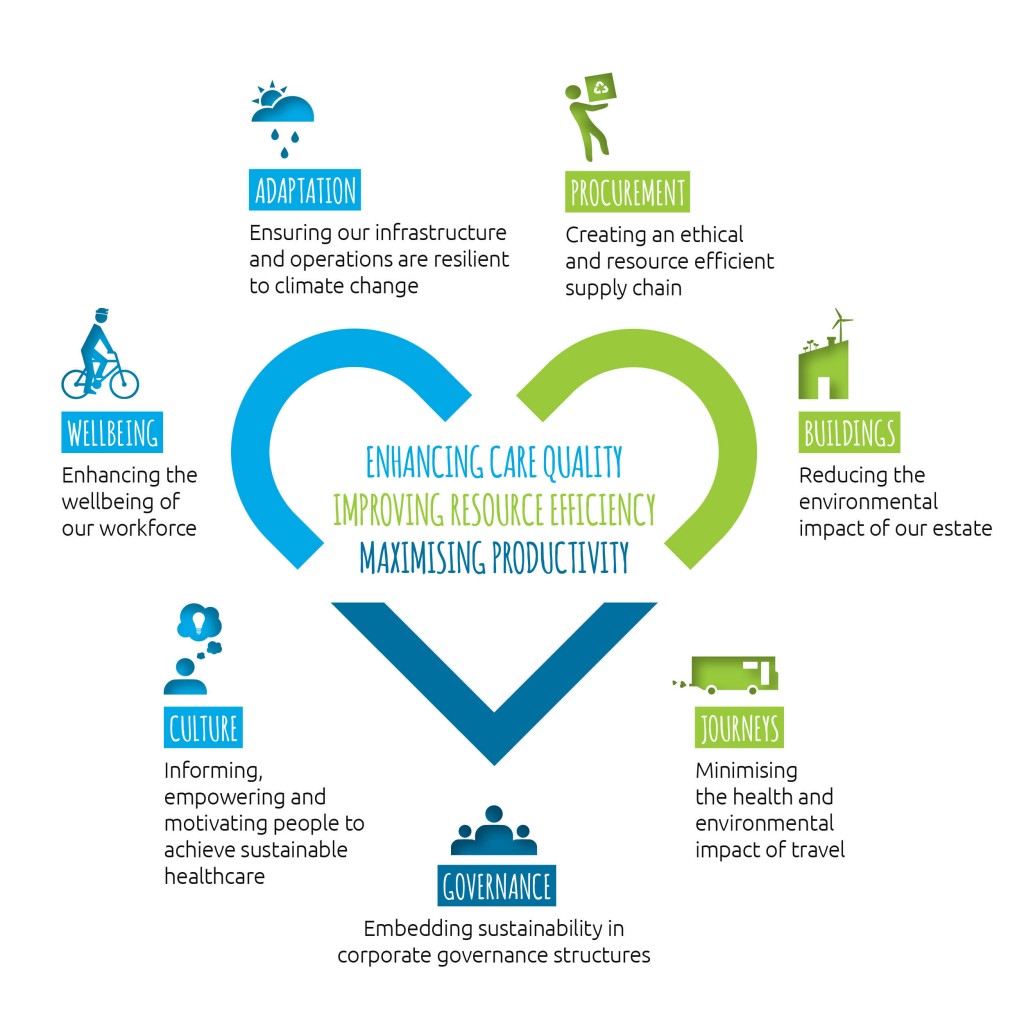
Connecting the business and engaging staff
Care Without Carbon is designed to integrate with the organisational vision and transformation programmes, so that sustainability isn’t an ‘add on’ but instead is embedded within the structure of the organisation. The focus shifts away from asking busy people to do more, but instead asks them to do things differently.
A key element to Care Without Carbon is our behavioural change campaign, Dare to Care.
Paula Head, chief executive at SCT, said: “As a responsible NHS trust, we want to encourage our dedicated staff to help us deliver healthcare in a greener and more environmentally responsible way.
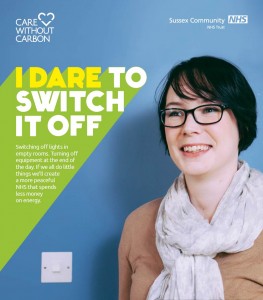
“Staff are being asked to sign up to a challenge to help reduce waste and carbon emissions. This could be anything from printing double sided, switching off lights or taking the bus to work instead of driving.
“By taking part in the Dare to Care challenge our staff can have some fun and work in a way that’s better for them, our patients, our community and the environment.
Reap the benefits
Any NHS organisation can benefit from adopting the Care Without Carbon programme – rewards reach across finance and energy performance, to staff wellbeing and enhanced patient care. Care Without Carbon’s co-ordinated approach to sustainability will:
- Improve employee health and wellbeing – reducing stress and sickness absence.
- Enable better patient care during floods, heat waves and other extreme weather events, which we are seeing more of due to climate change.
- Boost cost savings across operational areas – through smarter travel, waste and energy solutions.
- Reduce your carbon footprint in line with legal requirements.
- Enhance your reputation by setting the standard for sustainable healthcare.
The proof’s in the pudding
We’re very proud that Care Without Carbon has won several awards already – three at the 2015 NHS Sustainability Awards in the categories of Human Resources, Clinical and Behaviour Change.

However awards don’t come without results – and we are very proud of the difference that Care Without Carbon is already making. Working with Sussex Community NHS Trust we’ve cut carbon emissions by 18% and counting – working towards an ambitious carbon neutral goal. Business mileage has dropped by 500,000 miles, and fleet emissions have gone down by 17%. We achieved zero non healthcare waste going to landfill, with 68% non-healthcare waste recycled. The cumulative cost savings are expected to reach £4.75m.
In addition, our work with East Sussex Healthcare NHS Trust has already identified over £500,000 cost savings in one year and we’ve set in place a sustainable development management plan to reduce carbon emissions by 34% by 2020. Mark Paice, Assistant Commercial Director Estates said, “The Care Without Carbon approach has provided a simple route map that staff across the Trust can understand and it’s already proving very effective – over half a million pounds in savings identified for this year.”
Find out more
You can discover more about Care Without Carbon and the Dare to Care campaign by visiting our website www.carewithoutcarbon.org. Or you can email [email protected] and we’d be happy to get in touch with you to share more about our work.
http://www.carewithoutcarbon.org/fresh-approach-sustainable-healthcare/
]]>
With increasing legislative, ethical and stakeholder pressure to implement energy savings projects, many organisations are struggling to manage the number and complexity of projects they have to deliver.
Global access, transparency of data, automatic report generation and sorting of projects by multiple criteria are just some of the features of a new web-based software tool, Energy Activator®, to be launched by energy specialists JRP Solutions at Eco Technology 2015.
“From our experience working to deliver continuous improvement projects, we understood exactly the challenges faced by organisations trying to manage multiple projects across multiple sites and often globally too. We have designed and developed Energy Activator® to address these challenges,” says JRP Managing Director, Jes Rutter. Energy Activator® is a dynamic, user-friendly, web-based project management and reporting tool that enables the capture of energy reduction ideas and facilitates the effective management of a portfolio of energy reduction projects that will significantly improve the cost, environmental and operational performance of industrial businesses.
(Click here to for a video intro. For a full demonstration, contact [email protected])
How does it work?
Improvement ideas and opportunities are uploaded to a web based database where they are stored and evaluated in terms of their cost, energy and environmental impact and then prioritised accordingly.
Selected improvement opportunities are subjected to a rigorous gated process requiring stakeholder sign-off at each stage before it can then pass through to the next stage of assessment and approval.
Individual improvement opportunities may be grouped together to form unique projects with all associated documents, images and schematics being stored on the same database providing easy access to all relevant information.
Energy Activator® may be accessed from anywhere in the world and the visibility of the stored information may be restricted, if required, in accordance with the structure and specific needs of the business.
The management reports generated by Energy Activator® provide valuable operational, commercial and environmental information that help to inform capital planning, budget forecasting and environmental reporting.
The benefits:
- Saves time, money and resources
- Provides a constantly 'live' listing of project status
- Ensures consistency of process and reporting
- Gives global access and transparency of data
- Supports strategic and tactical decision-making
- Provides inspiration for new energy ideas
- Captures all energy ideas, opportunities and projects
- Aids prioritisation and selection of investment projects to maximise ROI
- Gated project governance process ensures stakeholder buy-in
- Captures all data, images and documents
- Generates automated and bespoke reports
- Supports the requirements of ISO 50001 accreditation
Energy Activator® offers considerable benefits over existing products and methodologies and can be licensed from JRP Solutions who will provide appropriate training and support.
For more information please contact [email protected], or call 07790 888321
]]>Visitors could see, with the variation in property and types of refurbishment , great examples of what can be done simply, cheaply and often by the owners themselves. They were also able to enjoy a spot of tea and cake at eco award winning Henry House - Karen Simporis, the owner, is one of the speakers at The Eco Technology Show.
The trail included workshops on draughtproofing, solar PV and energy switching as well as state of the art newbuilds on the beaches at Lancing and Worthing (Lancing Beach and Splashpoint Pool), a 1930's school (Downsbrook) and workshops/presentations at 3 community centres (Sidney Walter, Maybridge and Community House).
Janet Cranch in South Farm Road, (also speaking at The Eco Technology Show) was a great example of what a 70 year old lady can do with a bit of some grit and determination. Janet insulated under her floorboards, single handedly stripped out her fireplace in order to put in a woodburner, and demonstrated how one can live on a state pension in a warm, cosy 1930's home.
The award winning Relish Show Flat showcased a local housing authority refurbished flat with state of the art energy monitoring systems and countless eco friendly features. It also features as a teaching resource for Worthing Homes, where residents have access to free energy advice and assistance.
The Eco Open House team will be shortly planning another trail, hopefully for April 2016, and will be looking for prospective householders, businesses, sponsors and advertisers. Anyone who is interested in taking part, please contact [email protected].
Find out more about Eco Open Houses with a talk from some of the participants from Transition Town Worthing on Friday 12th June at 4pm in Seminar Area 2.
]]>
Ranked in tier 1 by The Legal 500, J A Kemp is one of the largest UK and European Patent and Trade Mark Attorney firms, with offices in London, Oxford and Munich.
Many of J A Kemp’s attorneys have a special interest in clean technology. They deal with inventions in areas as diverse as fuel cells, renewable energy generation (in particular wind and wave energy, solar power and bio-reactors), biofuels, recycling, water treatment and combustion engine management.
The firm is an active member of the London Cleantech Cluster (LCC), and regularly hosts seminars and events to help inventors and organisations ensure the commercial success of new and innovative green technologies, the next of which is being held on 18 March and is entitled "What to do When Someone is Infringing Your IP - Yes, SMEs Can Afford to Enforce Their IP".
With strong connections to many UK universities and research and development organisations, J A Kemp has a wealth of experience in using the UK-IPO "Green Channel" to accelerate the examination of UK patent applications relating to clean or green technology. Indeed, such is the firm’s dedication to cleantech clients that they do not charge for requesting combined search and examination and entry into the Green Channel at the UK Intellectual Property Office.
J A Kemp also has its own environmental policy and carbon reduction programme, supported by rigorous data collection and monitoring. This commitment to managing its environmental impact specifically by reducing its carbon footprint has been recognised through certification of the firm’s programme by Carbon Smart.
During the event J A Kemp Patent and Trade Mark Attorneys are offering free, informal one-on-one clinics, where delegates can have their questions about intellectual property matters answered. There is no charge to attend and no obligation to take further advice.
To book your 20 minute session, please email [email protected]
For more information, visit www.jakemp.com.
]]>Neil’s Story – Why Aquapax?

Neil was on holiday with his wife and family when the ‘first’ Asian tsunami footage appeared on our TV screens back on 26 December 2004. The powerful images made him feel both guilty and helpless – particularly when his considered plans to assist this ‘water based’ humanitarian crisis were vetoed within the corporate structure of his then employer.
This led him to work on a disposable portable water container suitable for long-term storage, with comprehensive integrity in terms of function and carbon footprint. This became a near obsession and developed ultimately into his mission of launching a premium consumer brand called AQUAPAX. “My strategy evolved, to swim up-stream when the ‘institutions’ of the world would not work with my unproven new business.” Says Neil.
“Aquapax is a wonderfully pure natural mineral water, sealed from light and air to stay fresh with a practically indefinite storage life. The water is sourced from deep beneath a protected nature park in Germany, where no commercial farming in the immediate area means Aquapax is incredibly pure.
For anyone who remembers their chemistry, it has a naturally low mineral balance with a near perfect 7.065pH and contains less than 0.3mg/l (parts per million) of nitrates making it suitable for infant consumption and people with virtually any type of diet restrictions. I sourced the water from Germany because of the purity of the source allied to their open minded attitude to my carton water idea. The ‘proof of the concept’ was that Aquapax won the internationally recognised QATRAH Award as ‘Best Bottled Water’ at its very first public outing. It is also the only UK bottled water declaring its suitability for infants.
If you look closely at an Aquapax water carton, this is what I hope you will see… Positioned at the base of the carton, is one of our registered trademarks ‘A PURE THIRST FOR THE ENVIRONMENT’® which forms the foundation of my brand – this is fundamentally why Aquapax exists. Above this sentence, I placed my signature between illustrations of waves to represent the beach from my childhood. I grew up in Durban, on the east coast of South Africa at a time when beaches weren’t places that plastic bottles washed up on.
Above my signature is a bird in flight. It’s not just any bird, it’s Jonathan Livingstone Seagull – a story written by Richard Bach about a seagull learning about life and flight that has inspired me to live the life I’ve chosen and to try not to take too many short cuts.
I’ve always loved trees and working with sustainable forest sources as a renewable material was the only true way I could think of to ensure the future of the world’s great forests. Look closely at the front of an Aquapax carton and you will see this clearly in the heart shaped light coming through the branches of ‘the tree of life’, with its roots running deep into the earth below.
Fanning out from behind the tree, you can see suns rays shining brightly – I wanted this image to be uplifting to signify positive hope rather than represent a negative castigation of the pretty labels on so many plastic bottle ‘competitors’.
Above the tree and the Aquapax logo, there are three birds migrating, which for me signifies the change in consumer awareness, represented by a migration which no-one tells birds to do - they simply know when the time is right and fly off. I can feel this movement among consumers leaning towards greater ecological awareness – it’s a slow migration but it’s real…
Finally, at the top of the carton is the statement ‘PURE WATER EVOLUTION’ – I know Aquapax is not yet perfect and we have bio-polymer caps and liners on trial as I type. Our water source is impeccable – which was my number one priority – and the other elements will follow, evolving the product and brand as all great products and brands have to ultimately do.
“Aquapax tastes like pure fresh natural water should with no taint or aftertaste; consider how fresh air has absolutely no smell at all and you’ll get it. As an environmentalist, the carbon footprint of an Aquapax carton is less than half that of a single-use plastic bottle and the empty cartons can be safely re-filled for reuse by the original owner before recycling. More compelling for me is if people would only consider how it takes more water to produce a plastic water bottle than the bottle is physically capable of holding. That in a country where the tap water is perfectly adequate drives me on through the dark times!”
Aquapax is currently available across the UK and Ireland via quality independent wholesalers like Infinity Foods, Cotswold Fayre, Complete Sports Nutrition and Aqua Amore. It’s sold online directly through the company website or via amazon.com, winnaturally.com and hollandandbarrett.com (please read some of the genuine customer reviews) while it’s available in the high street through selected London Waitrose stores, Holland and Barrett, Selfridges, Fortnum and Mason and many other good independent retailers, cafs, farm and whole foods shops, boutique hotels, sports gyms, spa salons and yoga studios across the UK, France and further afield.
“Aquapax is one of the best products no-one’s ever heard of” says Neil and he’s planning to rectify that later this year through a crowd funding exercise to generate the funds for a more comprehensive PR campaign.
Meanwhile, there’s always the internet: www.aquapaxwater.com, www.facebook.com/aquapaxwater or on Twitter: @aquapax to discover more information.
AQUAPAX began with a strong ethics led foundation as a revolution against the cheap, yet ecologically costly status quo of the bottled water industry. Our call to action is ‘Ditch the plastic’ and who knows where this call will lead?
]]>